
Latest Stories
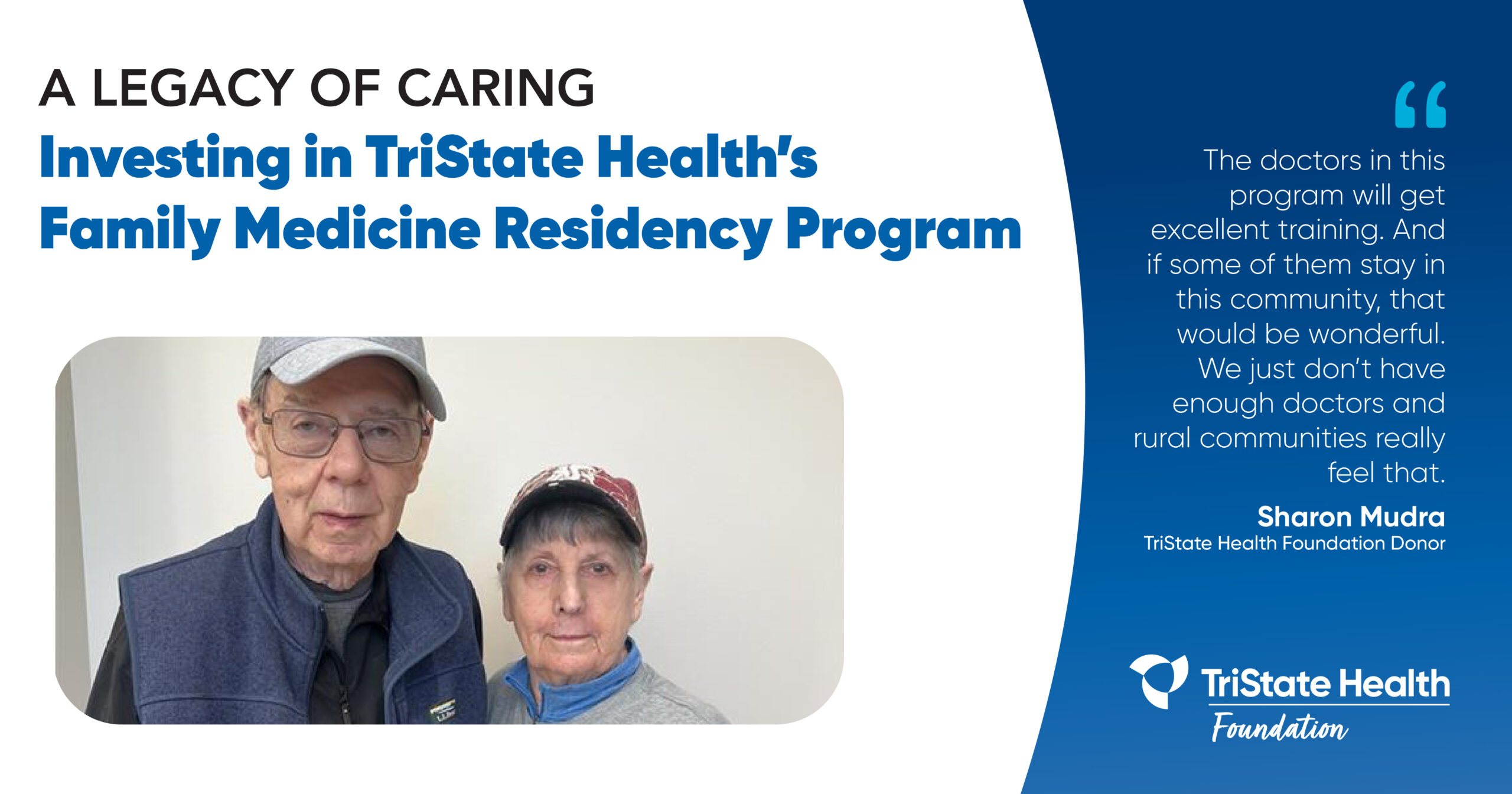
A Legacy of Caring: Investing in TriState Health’s Family Medicine Residency Program
Share
For Dave and Sharon Mudra, giving back has never been an obligation, it has always been a natural extension of who they are.
Dave and Sharon met in 1965, and collectively they built their lives around education, service, and caring for others. Dave taught history and economics for nearly three decades, helping students understand the practical skills they needed to succeed in life. Sharon taught alongside him in physical education. She coached, advised, and mentored generations of students. Together, they helped shape the future for hundreds of children. Their classrooms, gymnasiums, and athletic fields were filled with young people who saw them as trusted adults, role models, steady supporters, and family.
After retiring, the Mudras moved to Clarkston in 1999 to care for Sharon’s mother. They later provided care to additional family members, including Dave’s aunt, Harriet, for nearly a decade. Caring for their elders, walking alongside loved ones through significant medical challenges, and experiencing healthcare up close shaped their belief in the importance of strong, accessible, local medical services. “We’ve watched a lot of family go through medical problems over the years,” Sharon said. “We feel like supporting TriState Health was the thing to do, a local hospital that offers such great services.”
Since settling in the Lewis-Clark Valley, TriState quickly became an anchor in the Mudras’ lives. From routine care to urgent needs, they relied on TriState providers often, and they personally saw the compassion and dedication that define community-owned healthcare. “We just believe TriState does things the right way,” Sharon shared. “Patients come first. It’s all about care. Not profit.”
Their philanthropy to TriState began long before the hospital announced its new Family Medicine Residency Program. Over the years, Dave and Sharon contributed to imaging upgrades, expansion projects, and other initiatives that enriched local care. They attended fundraising events, connected deeply with staff, and became champions for the hospital’s mission.
But their generosity extends far beyond healthcare. Throughout their years in the Lewis-Clark Valley, the Mudras have quietly supported numerous local nonprofits and community causes, including education levies and initatives, the animal shelter, Habitat for Humanity, public radio and TV, and organizations needing help meeting essential needs. Giving locally, they said, has always been their way of strengthening the community they love. “We’ve been very fortunate in our lives,” Dave noted. “If we can help a little here and a little there, that’s what we want to do.”
When they learned about TriState Health’s new residency program, the Mudras knew immediately they wanted to support it.
TriState Health is currently in the planning phases of launching
a Family Medicine Residency Program, one of only four residency programs in the nation hosted by a Critical Access Hospital. Developed with academic sponsorship from Washington State University’s Elson S. Floyd College of Medicine, this program aims to address the urgent need for primary care providers in rural Washington and the Lewis-Clark Valley.
For the Mudras, that partnership made the decision to give even more meaningful. Both Dave and Sharon attended Washington State University, giving them a lifelong connection to the institution. They have supported the Elson S. Floyd College of Medicine for years, believing in its mission to train physicians who serve Washington’s communities. Supporting TriState’s new residency program felt like a natural progression, an opportunity to strengthen the connection between the medical school they believe in, and the local hospital they trust.
The Mudras believe this effort is not only timely but essential. “When we found out about the program, we jumped right in,” Sharon said. “It’s such a great idea. We need to keep doctors local.”
Their belief is rooted in personal moments of care. After the passing of their longtime primary physician, the Mudras transitioned to TriState Family Practice & Internal Medicine where they quickly felt the strength and compassion of TriState’s clinical team. They have also experienced firsthand care from TriState Minor Care, TriState Emergency, and have spent time in the PIFCU Inpatient Wing. The reliability, continuity, and personal nature of TriState’s providers and every individual who touched their journey have reinforced their desire to help bring more providers to the area.
“The doctors in this program will get excellent training,” Sharon noted. “And if some of them stay in this community, that would be wonderful. We just don’t have enough doctors, and rural communities really feel that.”
When asked what message they would share with future physicians or community members, Dave and Sharon’s answer was simple: “Nothing in life is free. If you want quality healthcare and want to be well taken care of, you should be willing to support the people providing it.”
Their philanthropic philosophy is one of gratitude and responsibility. They have saved diligently throughout their lives and now they feel privileged to invest in causes that make life better for others. They have also included TriState Health Foundation in their legacy giving plans, passing forward their commitment to community health for future generations. “We just want to make life better,” Sharon said. “Hopefully our legacy is that we did something good.”
The Mudras’ generosity will directly support the creation of a residency program that will train the next generation of family doctors, providers who understand rural medicine, who choose meaningful patient relationships, and who may stay to serve the Lewis-Clark Valley for decades to come.
Their gift is more than a donation; it is an investment in people, in local healthcare, and in the belief that small communities deserve world-class medical care close to home. TriState Health is deeply grateful for Dave and Sharon’s vision, trust, and unwavering commitment to strengthening the future of healthcare in our region. Their story is a reminder of what community philanthropy makes possible and how lifelong educators can continue changing lives long after retirement.
To learn more about TriState’s Family Medicine Residency Program and to donate, visit TSH.org/FamilyResidency